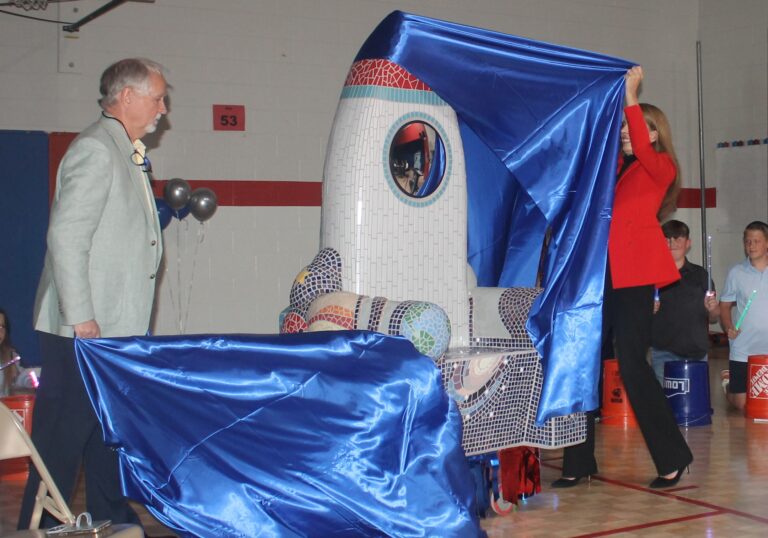
Rocket Chair unveiled at Rock Creek

Audience members who had an active role in the project stand up to be recognized.

EDITOR

Brian Justice

A major scientific project was officially christened on May 11 with the School Board witnessing Rock Creek Elementary unveiling its very own Rocket Chair — a mosaic sculpture showcasing the school’s rocket-based tradition.

The board’s regular monthly meeting was held at the school to unveil the project that was undertaken to create a lasting tribute involving a myriad of community members to get the job done.

Rock Creek enlisted a well-renowned artist — Sherri Warner Hunter — to craft the Rocket Chair, which features a mosaic pattern that includes small pieces of colored ceramic tile placed in a series of patterns on a cement-based frame, shaped like a chair with a rocket-shaped back. Hunter owns SWH Art Studio Inc. in Bell Buckle.

The presentation featured a congratulatory video provided by 1985 Franklin County High School graduate Dr. John Blevins, who is chief engineer for NASA’s Space Launch System Program, managed at NASA’s Marshall Space Flight Center in Huntsville, Alabama.

Blevins was not able to attend the meeting, but he provided the video in his absence.

“I congratulate Rock Creek Elementary School for this wonderful invention they brought forward — the Rock Creek Rocket Chair,” he said in the video, adding later: “Public education is the very backbone of our society. It’s what gets us where we are and, in this case, helps us get astronauts to the moon.

“This is such a wonderful device, and I’m glad to see such creative work all the way down in our elementary schools. The real landmark, hallmark of any society is how we treat science, art and exploration, and I see all this in the Rocket Chair.”

Hunter said the Rocket Chair mirrors and pays tribute to the Andromeda Galaxy, and the process to do so is quite extensive.

She said that each mosaic tile on the chair started out as a commercial 8-inch by 8-inch high-fired ceramic piece. She added that edges were cut off of the tile so that the surface was flat before the shapes were made.

Hunter said the blue section was cut into strips, then into squares, using a diamond wet saw made for tile. She added that each square was then sanded on a diamond wet grinder.

Wherever a triangle was needed to fill the row design, either a wet saw or hand nippers were used, and any piece that was hand-nipped needed to have its edges sanded.

Hunter said that the planets were mosaicked in what she refers to as “interesting shapes.” She added that the tiles go through a similar process of cutting, except the strips are “wonky,” and the sizes they are cut in depends on where they will be placed — the tighter the curve of the surface, the smaller the pieces have to be so that no edges or points are sticking up.

She said the Andromeda Galaxy shapes required much more nipping and the use of a spindle diamond grinder, typically used by stained-glass artists, to smooth the edges of the convex curves.

Principal Dr. Barbara King said Rock Creek welcomes what the mosaic sculpture will bring to the school.

“We’re the home of the Rockets, which is our mascot, and we’re going to put this in the foyer,” she said previously while the work was in-progress, referring to where the sculpture will be placed.

King said it will be among the first things anyone sees upon entering the school from its front-door area.

She said the Rocket Chair will be a lasting tribute to the school’s history and tradition, plus a great conversation piece for returning former students.

“We’re very excited about it,” she said, adding that it is geared to bring the community together.

She said the finished product is extremely pleasing.

“Watching this project evolve from a concept to a stunning masterpiece has been incredibly rewarding,” she said. “The dedication, patience and precision required to complete this mosaic mirrors the exact qualities we strive to instill in students every day.

“It is a proud moment for Rock Creek Elementary students. The final product is more than an impressive work of art. It is a legacy piece of Rock Creek history.”

King said that each tile represents a voice, a hand and a moment of dedication from the community.

“This chair will stand for years to come as a symbol of our students’ capability, creativity and pride in the Rock Creek and Estill Springs community,” she said.

School Board Member Sara Liechty, who was a driving force behind the project with King, echoed the principal’s assessment.

“It has been my honor to work with Rock Creek on this permanent art project,” she said. “I know that the community support and participation have built both positive memories and valued experiences for all who have been involved.

“Not only does the school have valuable and beautiful mosaic art for its students and families, this process underscores the importance of working together to accomplish goals.”

Liechty said the project involved securing the funds for an $11,500 total investment.

She said most of the funding was provided through a Tennessee Arts Commission grant with about $2,000 coming in from donations to meet the $11,500 goal.

Liechty explained that the purpose of the project is to draw attention to the arts, their cultural and historical significance and their impact on learning.

“In 10 or 20 years, former students will be coming back and seeing and remembering this,” she said, referring to the Rocket Chair and their experience in sculpting it.

Liechty said it is significant to have someone of Hunter’s level making her mark in one of the system’s schools.

“I want people to know that we have an internationally known artist of this caliber working in our school with our children,” she said.

In addition to students and teachers individually placing tiles on the sculpture, community members also lent a helping hand, including Sheriff Tim Fuller, School Board members, Franklin County Foundation for Excellence members, elected officials and other civic leaders who were invited to contribute while the work was ongoing.

Liechty said Hunter was selected because she has an extensive track record with her mosaic sculptures being very prominently placed in Tennessee and other parts of the nation, including Long Beach, Santa Cruz, Torrance and Palo Alto in California; Coppell, Texas; Lebanon, New Hampshire; and Albany, New York. She has also been called on for her expertise internationally in Puente Alto, Chile.

Her work can be viewed at The Parthenon Museum and Monroe Carrell Jr. Children’s Hospital at Vanderbilt University in Nashville and Fletcher Creek Park in Memphis, and she has sculptures at Bel-Aire, Robert E. Lee and Farrar elementary schools in Tullahoma.

Hunter said she “was given this wonderful opportunity when the school contacted me” and added she greatly appreciates the gesture.

She explained that each sculpture is unique in its own way.

“Each project I do is special,” Hunter said, adding, “This is my first rocket.”