County hosts Memorial Day ceremony

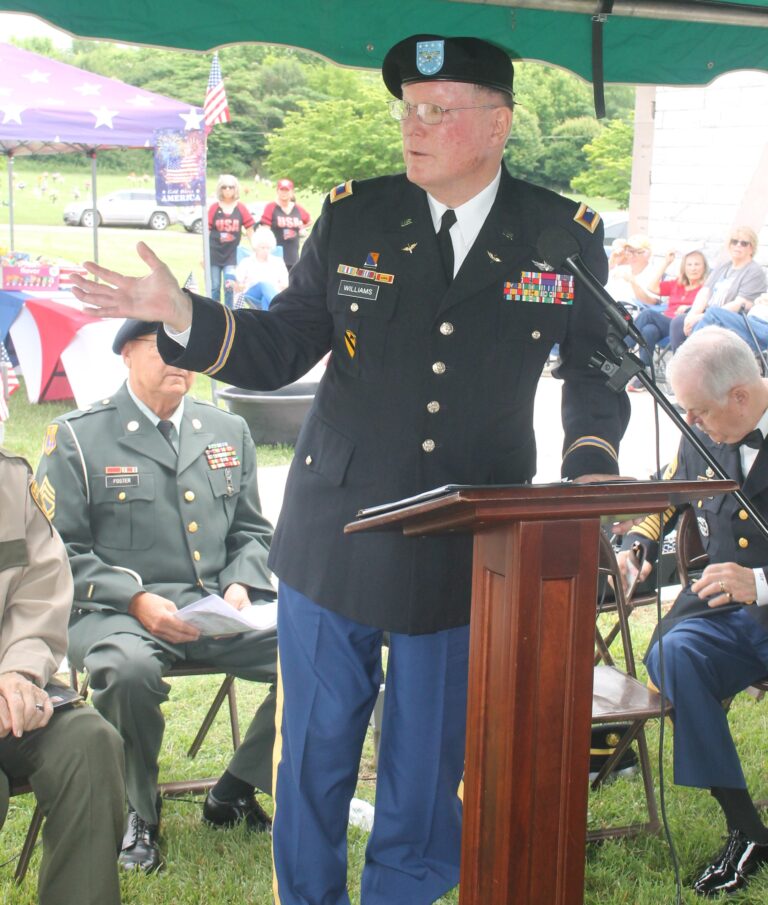
Guest speakers salute the flag during Monday’s Memorial Day ceremony.

EDITOR

Brian Justice

Monday’s annual Memorial Day service at Franklin Memorial Gardens reflected on a significant milestone in U.S. history that would not have been possible without military personnel making the ultimate sacrifice to ensure it would eventually arrive — the nation’s 250th birthday on July 4.

More than 100 attended the ceremony, sponsored by Disabled American Veterans Chapter 71, Veterans of Foreign Wars Post 1893 and Franklin County American Legion Post 44.

The event featured retired U.S. Army Col. Clinton Williams, who had been a helicopter pilot in the Vietnam War, as the keynote speaker.

In addition to paying tribute to the veterans who had served throughout the nation’s history, Williams highlighted the 82nd anniversary of D-Day, which was the beginning of the end of World War II in the European Theatre in 1944.

Williams said that in the nation’s 250 years of existence, more than 1.3 million died defending the Declaration of Independence.

“To remember and honor them is the reason for Memorial Day,” he said. “We all owe them a debt of gratitude that can never be repaid. We pledge that they will not be forgotten.”

Williams said the Declaration of Independence states that “ all men are created equal, that they are endowed by their creator with certain unalienable rights, that among these are life, liberty and the pursuit of happiness.”

He explained the phrase by saying: “That declaration has endured for 250 years, through trials and conflict and many military confrontations. Since the Boston Massacre of March 4, 1770 — which many historians think were the first shots of the American Revolution — killed five protesting colonists, the United States has fought in five formally declared wars.”

Those were the War of 1812, the Mexican-American War, the Spanish-American War, World War I and World War II.

Williams also said the nation has also been engaged in 238 military conflicts with the current Operation Epic Fury resulting in 16 U.S. service members killed in action.

“Today, as we remember and honor all of those Americans who have died while in service, there are two upcoming anniversaries that are forever historically significant on Memorial Day — the sixth of June, and the Fourth of July, the 250th anniversary of the Declaration of Independence,” he said.

Williams said that Operation Overlord, commonly referred to as D-Day, occurred after two years of intense planning to overcome the challenges of assaulting a heavily fortified beach front in Normandy, France. He added that the Allied Expeditionary Forces, led by U.S. Gen. Dwight D. Eisenhower, had set the invasion date as June 5, 1944, but it was delayed by a day due to weather conditions.

Williams said Operation Overlord involved training and transporting three million servicemen to the United Kingdom, manufacturing and stockpiling thousands of military vehicles, ammunition and supplies and providing 5,000 ships and 11,000 aircraft.

“It was an extraordinary, complex plan with precise timing for the assault on Normandy,” he said.

Williams said five U.S. divisions were involved in the assault on D-Day, including the 82nd and 101st Airborne divisions and the 1st, 29th and 4th Infantry divisions. All were supported by massive U.S. Army Air Corps and Navy units, he added.

He said the aerial assault’s objective was to isolate the landing beaches, disrupt and prevent German counterattacks and link up with the advancing naval-supported ground forces.

“The Germans were taken by complete surprise,” Williams said. “The widely dispersed paratroopers caused great confusion and chaos.”

However, he said the price of the invasion was high with 10,300 allied service-member casualties, including 4,900 U.S. casualties with more than 2,500 killed in action.

“Yet the European Campaign had just begun,” Williams said, adding that it took 85 days to complete the Normandy/Overlord operation, and 11 months of heavy combat remained before victory in Europe was declared on May 8, 1945, referred to as VE Day.

Williams said Eisenhower spoke from Omaha Beach on the 20th anniversary of D-Day in 1964.

“It is a wonderful thing to remember what those fellows 20 years ago were fighting for, what they did to preserve our way of life,” Eisenhower said at the time.

Williams said Memorial Day is celebrated at thousands of locations across the nation and in many other countries as family, friends, comrades and patriots gather at cemeteries to pay tribute to those who died defending the nation’s way of life.

He said the United States maintains 26 permanent military cemeteries plus 30 memorials, monuments and markers in 17 foreign countries. He added that Arlington National Cemetery is the most well-known with 430,000 grave sites.

“Commemorations honoring the fallen warriors are not new,” Williams said, adding that tributes extend as far back as 4,300 B.C.

He explained that the first U.S. Memorial Day occurred on May 30, 1868, honoring Union soldiers killed in the Civil War, and prior to that, there were many similar local events involving Union and Confederate remembrances.

Williams said that in 1968, Congress officially declared the last day of May as Memorial Day.

The event’s lineup on Monday also included Mike Foster, a Gulf War veteran and lifetime DAV and VFW member, welcoming the audience as the master of ceremonies; the Pledge of Allegiance being recited by Army Vietnam veteran Ray Cutrell; Army Vietnam veteran Capt. Charley Watkins leading the invocation and ending the event with benediction; Dr. Jerry Anderson singing the national anthem and other patriotic music; Sgt. Maj. (E-9) Larry E. Williams, retired U.S. Army and DAV member, speaking ahead of Clinton Williams; and Clinton Vincent performing taps on the trumpet.

Larry Williams explained how the Memorial Day scene is repeated across the nation and around the world to remember the fallen military personnel.

“Our first obligation to them and to ourselves is quite plain,” he said, referring to fallen military personnel. “The United States and the freedom for which it stands, the freedom for which they died, must endure and prosper forever. As we honor their memory today, let us pledge that their lives, their sacrifices, their valor shall be justified and remembered for as long as God gives life to this nation.”

Larry Williams closed by citing a poem from A.E. Housman:

“Here, dead we lie, because we did not choose to live and shame the land from which we sprung. Life to be sure is nothing much to lose, but young men think it is, and we were young.”

Foster read the names of veterans from Franklin County who gave their lives in service to their country, which was followed by the playing of taps.

Veterans from Franklin County who died in World War I include:

Robert Ashley, Albert Banholzer, William J. Blansett, Harry Raymond Bohanan, Paul A. Bunn, Ernest J. Campbell, Henry C. Cates, William Oscar Clark, George W. Decker, Frank Epperson, Lester Evans, Enoch S. Foster, Thomas Gossage, Aubrey Grant, Robert Lee Hockersmith, William B. Hughes, Warnie Isbell, James L. Jones, Sam B. Kennerly, William M. Ledford, Arthur Marks, John T. Omohundro, Jeff D. Pack, Louis E. Pickney, Charles L. Russell, George D. Sheridan, Zeb Snelson, Benjamin G. St. John, Barney G. Taylor, Edward C. Tucker, Ike Turner, Peter J. Turney III, Thomas R. Wilhoit, David L. Wilson and Miles Woods.

Veterans from Franklin County who died in World War II include:

John Carwell Anderton, Murrell W. Anderton Jr., James Thomas Arnold, Patrick Ashburn, James Lenard Ashley, Palmer Sanford Awtrey, Ralph Thomas Barnes, Earl S. Bearden, Wilburn Lee Bradford, Roberts Leon Brinlley, Charles Buchanan, Francis Addelbert Caldwell, Frank Castell, Charlie K. Castleberry, Johnnie C. Certain, B.L. Chadwell, Willi Childress, Thomas Hershel Clark, Felix Warren Coker, John Meigs Commers, Roy Metcalf Copeland Jr., John Davis Couch, Paul B. Crabtree, Don Aaron Daniel, James Audrey Davis, Melton Dickerson, John Frank Dotson, Ralph Edgar Dotson, George Lensey Epperson, James F. Eslick, Claude Ellis Evans, Thomas William Farris, Edward Erskin Foster, Edward Franz, Sammie Mack Garner, William L. Garner, Davis Robert Grant, James E. Hamilton, George David Hendley, Andrew J. Hendon Sr., James Hill, William Gordon Hill, James Clifton Holt, William Hornbuckle, Robert Luther Hughes; Raymond Floyd Hulvey, Herman William Hunt, Charles William Hunter, James Corry Jackson, Marion Francis Jackson Jr., James R. Janey, Charles N. Jernigan, Paul R. Johnson, Charles James Juhan, Richard Allen Knott, David Lafayette Lynch Jr., Allen Lawrence McBee, Troy E. Mitchell, Charles Richard Money, Jessie Ray Moore, Thomas E. Murrell, George Clifton Myers, Leaburn D. Myers, Dwight Everette Nash, Walter Osborne, Fred Herbert Pack, James Clint Partin, John Leo Pickney, Ollie Ross Poe, Jack A. Past, H.B. Prince, Clyde Vance Proby, Herman Cornelius Reid, Haskell Dubose Rose, Jesse Berch Ross, Alton A. Shasteen, Louis Edward Simmons, Floyd Sims, James B. Skidmore, Claude J. Spencer, Ollie Steele, Osborne Stewart, John Arthur Taylor, George Wilson Temples Sr., William Aaron Vann, Joe D. Walker, James Howard Warren, James Gordon Weddington, Ernest Alex White, Willis L. Williams, Walter C. Willis, Billie B. Wiseman, Arnold Worthington and William Herman Yates.

Veterans from Franklin County who died in the Korean War include:

Howard G. Foster, Basil M. Grizzell Jr., Forrest M. Marshall, Willi Modena, Carl W. Payne Jr., James Rutledge, J.D. Sanders, Stanford G. Shahan, Franklin Shetters and Thomas W. Williams.

Veterans from Franklin County who died in the Vietnam War include:

Jackson Dillion Barnes, Jimmy Ray Clark, Charles Larry Housley, Joe L. Lujan Jr., Ronald Virgil Putnam, James Edward Robinson, George Rutledge Jr., Kenneth Parker Shasteen, John Henry Shetters, Gary D. Templeton and Randy Ward.

Veterans from Franklin County who died in Operation Iraqi Freedom include:

Nathan B. Clemons.

Veterans from Franklin County who died in Afghanistan include:

Gregory A. Posey and David A. Stephens.