Addressing decreased enrollment

Facing declining enrollment and a reduced state revenue stream, the Franklin Count}’ School System has its work cut out for itself to stay financially on track, according to County Commissioner David Eldridge.

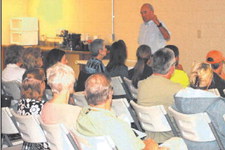
Eldridge has been holding a series of workshops called “Partnering with Government” to make Franklin County’s government operations easier for the general public to understand with the second gathering of the series being held on April 9 at the Franklin County Annex Building with about 65 attending.

The topic was the School District with Eldridge’s presentation focusing on declining enrollment and the revenue impact from it.

Eldridge said governments can climb onto slippery slopes where they are using non-recurring funds to pay recurring expenditures, which can lead to difficult financial situations. He explained that recurring items are repeated annually while non-recurring items are essentially a onetime appropriation or expenditure.

He said Franklin County, like other government entities nationwide, has faced an up-and-down trend with COVID-19-relief funding.

The country has received a total of $14.596 million in COVID-relief funding while the School System’s appropriation is at $14.9 million.

Eldridge said county residents also received federal dollars with many going on shopping sprees, which helped with salestax revenue. However, inflation followed suit, and the county has been faced with higher expenditures as a result of the cycle, leading to concerns about depleting the county’s fund balance — reserve funds left over at the end of budget cycles to be used for unforeseen expenditures and emergencies.

Eldridge described the COVID funding as a “blessing” and a “curse” because of how it arrived when greatly needed but left a lasting impact through the inflation it caused.

He used examples where inflationary costs were 25 percent more than their pre-COVID-19 levels. He said that the county’s annual growth in its revenue stream probably won’t be able to keep up with the inflation that has occurred, potentially leading to some difficult financial decisions that will eventually have to be made.

Eldridge said the School System has been faced with declining school enrollment and is down 1,004 students from a 5,669 total in 2011. He explained that the system receives $7,300 per student per year from the state, and losing 1,004 students equates to a $7 million annual loss in revenue.

He said the scenario presents questions about how the county will deal with declining enrollment.

Eldridge said the declining enrollment is likely to continue, and the reduced revenue pattern from the state is also likely to continue. He added that the recurring revenue remains less than recurring expenditures, and the School System most likely won‘t be able to hold its ground without making some major changes.

Eldridge reviewed the school general fund with $56.3 million in revenue, including $18.98 million from local sources, $37.1 from the state level, $182,047 from federal sources and $29,749 from other sources.

Eldridge said options include increasing local taxes or taking steps to reduce costs.

On the taxation side, he said options involve increasing property taxes or considering other alternatives, such as raising the sales-tax rate or implementing a wheel tax — all easier said than done.

Eldridge said the prognosis is that it could take up to a 25 percent property tax increase in the future if other steps aren’t taken to improve the School System’s financial situation.

The difficulty is the same on the cost-reduction side, Eldridge said, adding that the options include reducing the number of teachers, reducing support costs, moving to a value-based funding focus and streamlining the administration.

He said reducing the teaching force is also easier said than done because the student-enrollment decline is spread across the system’s 11 schools, and only one or two fewer students per classroom does not reduce teacher-pupil ratio requirements, making that option difficult to address.

Eldridge said Franklin County has the lowest salestax rate among nearby counties at 2.25 percent. Coffee, Bedford and Lawrence counties are all at 2.75 percent.

He said Franklin County has the option of increasing its sales-tax rate and could also implement a wheel tax at $50 per vehicle. He explained that each option would each raise about $2 million in additional revenue.

However, Eldridge said residents can force a referendum vote through a petition process, which can make it difficult to garner approval because many residents oppose tax increases if they are posed with the question.

Eldridge said the funding picture for the School System is only going to get more difficult because of competition from the state’s school-voucher system.

Tennessee’s schoolvoucher system, known as the Education Freedom Scholarship Act, is a statefunded initiative that went into effect at the beginning of the current academic year.

It provides up to 20,000 scholarships for K-12 students to attend private schools. The program offers more than $7,000 per child to be used on tuition and fees.

Questions were brought up by members of the audience about how those funds are traveling with students leaving the School System to attend Winchester Christian Academy.

“The voucher system from the state is going to be here,” Eldridge said, adding that a trend where students leave the School System to attend WCA is also going to continue.

Eldridge said the School System has also faced difficulty with academic proficiency.

He said the percentage of elementary school students performing at or above grade level in English/ language arts and math is well below state averages with the Franklin County School System ranked near the bottom in recent Tennessee Comprehensive Assessment Program test results.

A chart he provided showed 32.9 percent of Franklin County’s students are proficient in English/ language arts, and 27.4 percent are proficient in math.

The chart listed Williamson County at the top in both categories with 70.4 percent in English/ language arts and 71.8 percent in math.

Eldridge said that Franklin County’s proficiency levels are lower that Metro Nashville in both categories.

“We don’t want to be worse than Metro Nashville,” he said.

However, Eldridge said some of the county’s grade schools have fared well academically.

They include Broadview, North Lake and Sewanee elementary schools, which have been recognized for their high performance levels.

Eldridge said North and South middle schools have struggled academically as has Franklin County High School. He explained that he did not include Huntland School in the statistics because it is in a K-12 format.

Eldridge also addressed the cultural environment in the county’s schools, asking whether school culture is impacting student loss and academic performance.

He said behavioral boundaries need clarity and consistent enforcement, and disrespectful and disruptive behavior has been tolerated when it shouldn’t have been.

Eldridge also referred to the schools having a “permissive environment,” which has allowed the negative behavior to grow.

The end result has been a chaotic climate that has been non-conducive to learning, and teachers have often been left feeling like they have not been supported and have been frustrated because of it, he said.

Eldridge explained that the teachers have been held accountable in situations where they have had little or no control, which has led to their frustration.

School Board Member Sara Liechty said part of the reason enrollment has declined is that a focus on the arts has diminished, and students have left the system because band and musical offerings have been lacking.

She added that the School System allows non-system students to participate in athletic programs but doesn’t get any voucher-system money back from them, which has added to the funding problem.

School Board Member Linda Jones urged the public to contact School System officials with suggestions to address the problems.

“We need to hear from you,” she said, adding that the School System needs to find the answers.