AEDC at 75: The early years

In celebration of the Arnold Engineering Development Complex’s 75 years of operation, Lakeway Publishers will be delving into the history of the military institution this year.
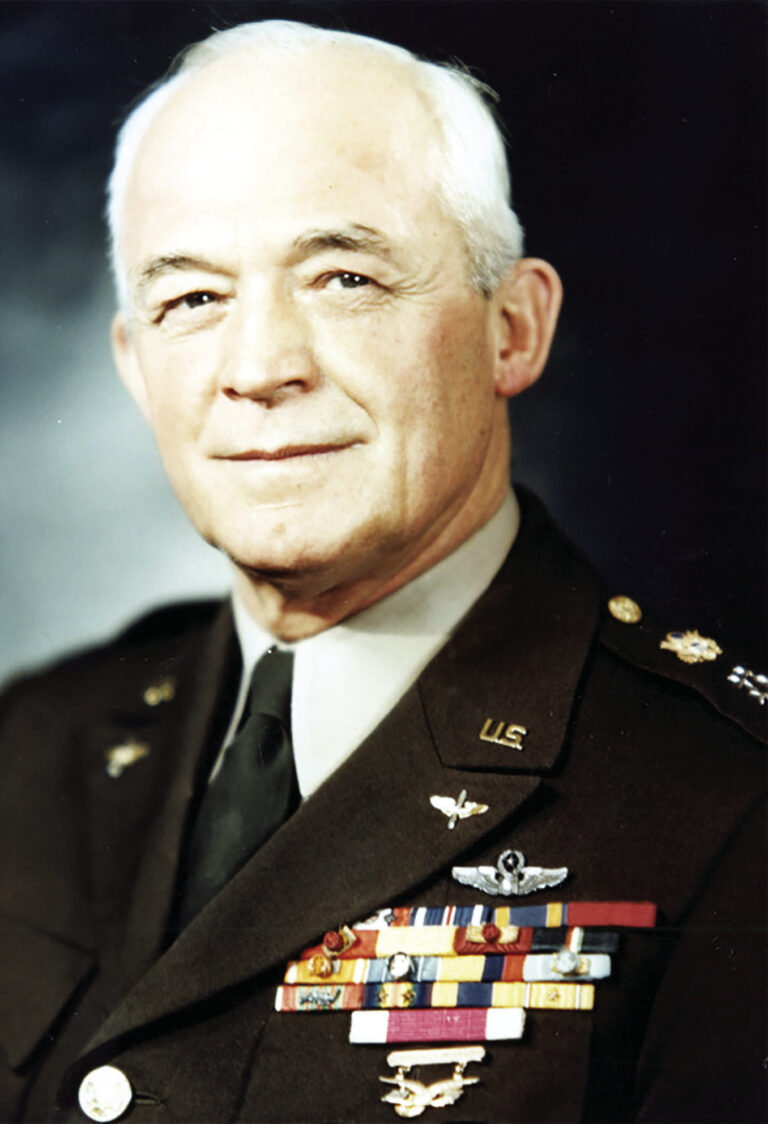
Hap Arnold’s vision takes flight A decade before the Arnold Engineering Development Complex was dedicated and several years before the establishment of the U.S. Air Force, Gen. Henry “Hap” Arnold was in England to assess production during World War II.
There, the commanding general of the Army Air Forces saw something that left him astounded. During his 1941 visit, Arnold observed a British plane flying without a propeller.
“Regardless of what anybody says, I want this for the U.S.,” Arnold said.
This sight would serve to accelerate advancements to the nation’s military aircraft technology as Arnold’s desire to bring such a capability to American planes would soon usher in the jet age.
The event also helped set in motion the steps that would eventually lead to the establishment of the AEDC.
American production lines during the second World War were focused on the manufacturing of military hardware for the Allied forces, meaning they would be unable to quickly restructure assembly lines to construct a new type of engine.
Aside from this, Arnold did not wish to disrupt the assembly of materials. Still, he was undeterred.
He asked General Electric to build a version of the British Whittle turbojet engine for American aircraft. He also sought the help of Bell Aircraft in the construction of the airframe that would house the engine.
In October 1942, the Bell XP-59A Airacomet, the first jet produced in the U.S., made its first flight near the current site of Edwards Air Force Base, California.
Arnold gleaned from this experience that the development of new equipment, such as the Airacomet, would require the establishment of research and development organizations and improved testing facilities.
A year before his visit to England, Arnold appointed renowned mathematician, physicist and engineer Theodore von Kármán to be his special adviser at Wright Field, Ohio. In his biography “The Wind and Beyond,” von Kármán wrote that in 1944, he and Arnold met at LaGuardia Airport in New York to discuss national defense needs.
According to von Kármán, Arnold’s mind was on the future.
“General Arnold wasted no time in coming to the point,” von Kármán wrote. “’We have won this war and I am no longer in it,’ [Arnold] said. ‘I do not think we should spend time debating whether we obtained the factory by sheer power or by some qualitative superiority. Only one thing should concern us. What is the future of air power and aerial warfare? What is the bearing of the new inventions such as jet propulsion, rockets, radar and the other electronic devices?
“I listened with fascination. I had always admired Arnold’s great vision, but I think then that I was more impressed than ever. This was September 1944. The war was not over; in fact, the Germans were to launch the Battle of the Bulge in December. Yet Arnold was already casting his sights far beyond the war and realizing, as he always had, that the technical genius which could help find answers for him was not cooped up in military or civilian bureaucracy but was to be found in universities and in the people at large.”
Von Kármán asked what Arnold expected of him. The scientist wrote that the general replied: “’I want you to come to the Pentagon and gather a group of scientists who will work out a blueprint for air research for the next 20, 30, perhaps 50 years.’” Arnold tasked von Kármán with forming an advisory group responsible to the Air Corps chief to provide recommendations on the future direction of aviation research.
At Arnold’s behest, the newly formed Scientific Advisory Group in May 1945 visited Germany to get a firsthand look at the testing and research facilities there. In Munich, Goettingen, Otztal, Kochel, Braunschweig and other captured test centers in Germany, the group found facilities, rockets, jet engines and aircraft – all more advanced than the Allies had imagined.
Among the advisory group members who made the trip to Germany was American scientist Frank Wattendorf. Like others who made the journey, Wattendorf, who was responsible for surveying German wind tunnels and engine test facilities, was alarmed by what he saw as German ground testing facilities were vastly superior to those of Allied nations.
But in the German facilities, Wattendorf also saw possibilities.
Site selection brings AEDC closer to fruition
After the Scientific Advisory Group’s May 1945 survey of German facilities was completed, American scientist and group member Frank Wattendorf remained in Europe to document his findings.
While there, he was notifi ed his father had passed away. Wattendorf boarded a plane to return to the U.S. During the long flight, Wattendorf summarized his findings from Germany.
His report, which became known as the Trans-Atlantic Memo, was the first recommendation for a site such as the AEDC.
“The present development and future prospects of high-speed jet airplanes are associated with an urgent need for forward- looking advances in research and test facilities for high-speed aerodynamics, propulsion systems and component parts,” Wattendorf’s Trans-Atlantic Memo states. “The scope of the German plans makes it essential that our own plans be certainly not less ambitious in the light of our future security. It is recommended that consideration and study be given the establishment of a new Air Forces research and development center.”
The memo was given to Brig. Gen. Franklin O. Carroll, then-commander of Wright Field’s engineering division and the first Air Service officer to be trained in aeronautical engineering. Wattendorf’s memo became the basis of Carroll’s presentation to Arnold’s Air Staff.
In that presentation, Carroll advised the Air Staff of the advancements the Germans had made in ground testing while underscoring the deficiencies in American test facilities. He noted that no facilities existed in the U.S. for the testing of turbojet compressors. Carroll further listed the necessary facilities for U.S. research and development.
Carroll suggested that the Air Technical Service Command be tasked with completing a preliminary study for the establishment of a “new Army Air Force’s Applied Research and Development Center for Fluid Dynamics.”
Carroll would later serve as the first commander of the AEDC.
On July 31, 1945, Maj. Gen. E.M. Powers, assistant chief of staff, materiel and services, gave Carroll the go-ahead to proceed with his suggestion. That October, Col. Paul H. Kemmer, Carroll’s deputy, formed a committee to complete the recommended study. A little more than two months later, the Kemmer Committee’s initial report was completed for submittal to Arnold.
Concurrent to the Kemmer Committee efforts, the Scientific Advisory Group was compiling its own report. That document, entitled Toward New Horizons, was published less than a week after the Kemmer report and called for the creation of a research and development facility that could be used for the study and development of jet propulsion, supersonic aircraft and ballistic missiles. The Trans-Atlantic Memo became part of Toward New Horizons.
“The Center for Supersonic and Pilotless Aircraft Development should be equipped with adequate wind-tunnel facilities to attain speeds up to three times the velocity of sound with large enough test sections to accommodate models of reasonable size, including jet propulsion units, and one ultrasonic wind tunnel for exploration of the upper frontier of the supersonic speed range,” Toward New Horizons states. “Ample facilities for the study of combustion and other characteristics of propulsion systems at very high altitudes should be provided.”
Both the Kemmer report and Toward New Horizons suggested utilizing captured German test facilities in a new installation to be located near large sources of water and electrical power. It was believed that the use of the German equipment would save nearly eight years in facility design and construction.
The Kemmer Committee report stated $300 million would be needed for the purchase of the site and the construction of housing, roads, utilities and the initial portion of the facility.
This report, titled “Proposed Air Engineering Development Center,” was presented to the Air Staff in January 1946. That March, Brig. Gen. H.I. Hodes, assistant chief of the War Department General Staff, authorized further planning on the proposed center. St. Louis-based engineering firm Sverdrup & Parcel Inc. was awarded a $1.5 million Army Air Forces contract to conduct this study.
S&P proposed several possible sites for the new center based on availability to electrical power, low population density and room for growth. In order of preference, the proposed sites were Moses Lake, Washington; Grand Wash Cliffs, Arizona; and the Tennessee Valley.
Meanwhile, the U.S. Air Force was formally founded as a separate branch of the military on Sept. 18, 1947, under the National Security Act of 1947. The planned research and development center would fall under the purview of the newly established service.
Moses Lake and the Grand Wash Cliffs were eliminated as possibilities due to potential vulnerability to attack and a water dispute between Arizona and California, respectively. This left the Tennessee Valley as the only remaining option of those recommended by S&P.
It was believed the Tennessee River could provide the necessary water. At the time, the Army was in the process of deactivating the Redstone Arsenal. The use of these facilities would save time on the construction of housing and offices.
However, when the Air Force began showing an interest in Redstone, the Army expressed reservations about closing it.
U.S. Sen. Kenneth Mc-Kellar of Tennessee stepped in with a proposal. The state of Tennessee would donate Camp Forrest to the Air Force as the site for the Air Engineering Development Center.
Located in Southern Middle Tennessee near Tullahoma, Camp Forrest was one of the Army’s largest training bases during World War II and was an active Army post between 1941 and 1946. The site offi cially became a prisoner of war camp in May 1942, housing Italian and German POWs.
By 1946, World War II had ended. Camp Forrest and the nearby William Northern Field, an air training base, were declared surplus property.
The Air Force accepted McKellar’s offer.
On April 28, 1948, Camp Forrest was named as the site for the Air Force’s new Air Engineering Development Center.
Action was taken in the fall of the following year that cleared way for the construction of Arnold Air Force Base, initially home to the AEDC and later headquarters of the entire Complex.
Groundwork begins
On Oct. 27-28, 1949, then-President Harry S. Truman signed the Unitary Wind Tunnel Plan Act of 1949.
The first bill authorized a unitary plan for the construction of transonic and supersonic wind-tunnel facilities to bolster national defense. The second bill authorized $100 million appropriated by Congress for the construction of the Air Engineering Development Center.
“There is hereby authorized to be appropriated, out of any moneys in the Treasury not otherwise appropriated, to remain available until expended when so specific in the appropriation act concerned, (a) not to exceed $100,000,000 for the establishment and for initial construction, installation and equipment of the Air Engineering Development Center authorized in this title, including expenses for necessary surveys and acquisition of land and (b) such sums as may be necessary to carry out the other purposed of this title,” the act reads.
On March 3 of the following year, the secretary of defense approved the construction of the center and, less than a month later, the Air Force awarded its first construction contract – the manufacture of cranes for the Engine Test Facility.
The Army Corps of Engineers was charged with overseeing part of the design of the AEDC and all its construction. The Tullahoma District of the Army Corps of Engineers was established in late 1949 to serve this purpose. The agency awarded its first contract for a perimeter fence and access road. This work began in early June 1950.
Less than a month later, the Army Corps of Engineers awarded a contract for a project to dam the Elk River to create a reservoir to provide water for AEDC test facilities.
Access to a substantial water supply was needed as it was determined early on that center operations would require millions of gallons of cooling water. The damming of the Elk River created what would come to be called Woods Reservoir, a repository that, since the project was completed, has not only continued to provide Arnold Air Force Base with cooling water but has served as a local for outdoor recreation.
The dam was a major focus of early construction planning. The first construction directive for AEDC was actually issued in January 1950 when the headquarters of the Air Force tasked the Army Corps of Engineers’ chief of engineers with the preliminary investigation and design of the dam and preliminaries to land acquisition as well as administrative expenses for the Tullahoma District.
Planners recognized that a reservoir could be created by damming the river.
St. Louis-based engineering firm Sverdrup & Parcel Inc. was once again called upon, this time to study the matter of the Elk River Dam.
The engineering firm recommended that the reservoir- design criteria be determined by the Army Corps of Engineers.
The dam project was completed in September 1952.
A primary pumping plant was constructed on the north side of the reservoir upstream of the dam. This plant was needed to pump water from the Elk River reservoir to a secondary reservoir located within the AEDC test area.
It would be the job of a secondary pumping station located within the main AEDC area to pull water from this secondary reservoir and transmit it to the test facilities.
Transmission of the water from the Elk River reservoir to the one located at the center was provided by a high-pressure steel pipeline.
As was recommended, much of the machinery Germany utilized to develop hardware for its war effort was transported to America for usage at AEDC and other Air Force facilities.
Fifty-eight railroad cars, two barges and a number of heavy trucks were required to move German and Japanese equipment from Alameda, California; Memphis; and the port at Mobile, Alabama, to Tennessee. Captured German equipment became the cornerstone of the Engine Test Facility.
The first jet engine equipment installed at AEDC was taken from the Bavarian Motor Works jet engine facility in Munich at the close of World War II.
The U.S. also acquired components from the Otztal sonic wind tunnel, which were used in the AEDC Propulsion Wind Tunnel.
“The Air Force made a strong case for erection of the German equipment already stored in the U.S., particularly the BMW Engine Test Facility, which was immediately available and urgently needed for the testing of existing Air Force jet engine prototypes,” American scientist and Scientific Advisory Group member Wattendorf said after the group’s May 1945 visit to Germany to assess captured test facilities there.
German expertise played a key role in the development of the AEDC. Under Operation Paperclip, German scientists and engineers were recruited to work in the U.S.
Some of these scientists and engineers helped reerect German facilities at AEDC.
The German company Kochel provided the design used to develop what would later become known as the von Kármán Gas Dynamics Facility.
In late March 1950, then-Secretary of the Air Force W. Stuart Symington directed that the new center would be operated by a corporation under contract to the Air Force. The reasoning behind this was to keep in place a stable, more tenured workforce that would accumulate experience and knowledge with the AEDC test facilities, thus aiding in troubleshooting due to personnel familiarity with the facilities, facilitating the passage of amassed expertise to new hires and reducing time spent on training as new staff would not have to be onboarded every few years.
“A military workforce is, by design, transient,” “Beyond the Speed of Sound,” a book detailing the history of the AEDC, states. “Roughly every two to three years, new personnel transfer in or out, making it difficult to build corporate knowledge.
“The original rationale for operating AEDC with private-sector personnel included limited availability of qualified technical personnel in the Air Force, either as military or civilians. It also recognized the flexibility afforded by the use of private companies who could hire and terminate employees with much more ease than could the federal government. In addition, a private company has more ability to tailor its pay scales or even individual salaries to market rates, thereby giving them the ability to recruit personnel with special skills who may not be available to the government as federal employees.”
On June 29, 1950, the Arnold Research Organization, the corporation established to manage and operate the Air Engineering Development Center, was awarded a contract from the Air Force to cover the first 15 months of operation.
The Arnold Air Force Base warehouse was the first building constructed on the installation. It would soon serve as backdrop for a signifi cant event in the history of AEDC.
Arnold passed away in January 1950. While he didn’t live to see his vision fully realized, the AEDC would become an enduring part of Arnold’s legacy.